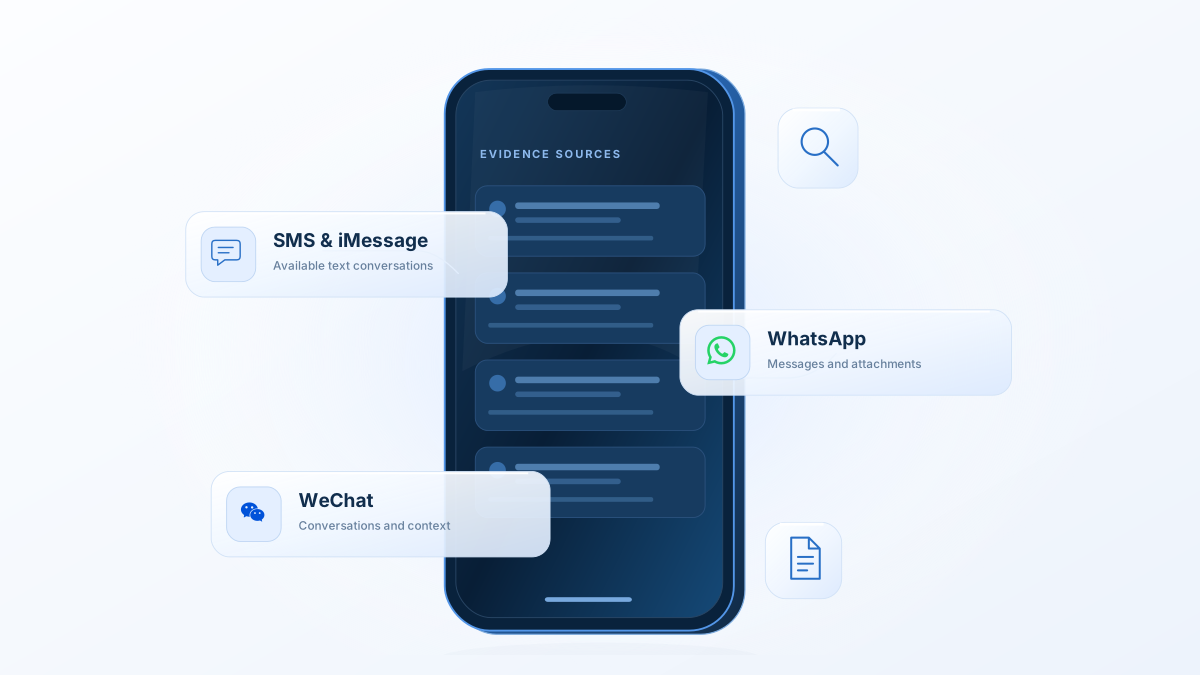
Start with the device that holds the conversation
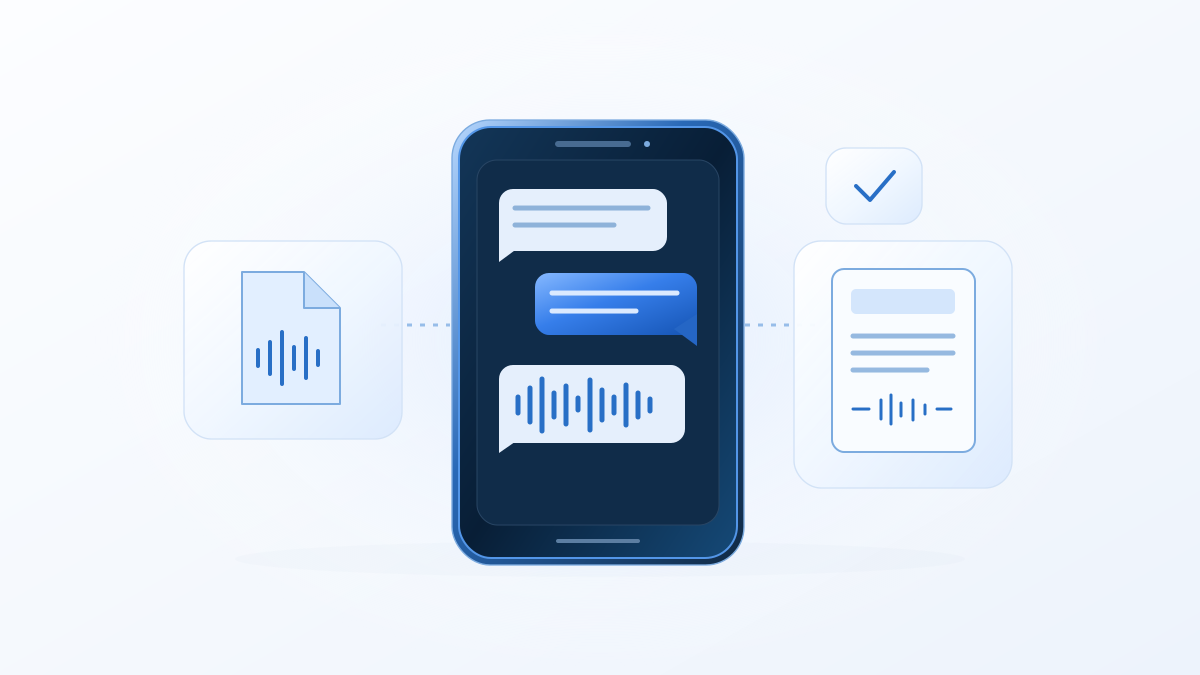
A client’s WeChat conversation may contain the agreement, admission or instruction at the centre of a dispute. Some of it may be written. Some may be spoken in voice messages. A few screenshots can show why the conversation matters, but they may leave counsel without the underlying records or a practical way to review the audio.
WeChat conversation history is principally stored on users’ devices. Lawyers should therefore plan preservation around the phones, computers and available backups that hold the relevant history, rather than assume a complete conversation can later be obtained from the service provider.
Early forensic collection helps preserve the messages, their context and associated media before a phone is replaced, reset or lost.
Where does WeChat store chat history?
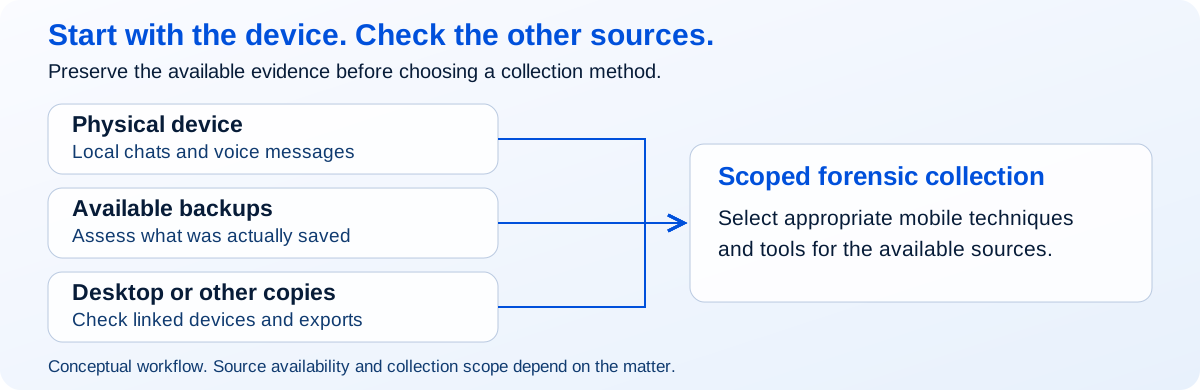
WeChat’s storage model differs from a mailbox that can routinely be collected from a cloud account. Conversation history is held locally, and changing phones does not necessarily make the earlier history appear on the replacement device. Existing transfers, desktop copies and backups can be important additional sources.
Tencent describes local storage and user-controlled backup, deletion and transfer for Weixin, the related service used in mainland China. The practical preservation lesson is the same: identify where this client’s conversation actually exists. [1]
This does not mean WeChat never uses servers. Messages travel through the service, and particular features can involve server-held information. It means counsel should not rely on a persistent, complete provider-held chat archive as the preservation plan.
Ask about the current phone, previous phones, WeChat on a PC or Mac, and any existing chat backups or migrations. Where appropriate to the legal process, another participant’s device may provide a further source of the conversation.
Why mobile forensic collection matters
When the relevant history is on a phone, access to that physical device is often the starting point. Mobile forensic techniques and tools allow an examiner to acquire available application data, identify relevant conversations and relate messages to their supporting records and media.
Possession of the phone does not prescribe one extraction method. The appropriate collection may involve a logical, file-system or backup-based acquisition, depending on the device, operating system, application version and available access. A physical extraction is not required or possible in every case.
The purpose is to preserve and examine a documented source of evidence. DFI can then assess the available participants, chronology, message content and attachments, rather than ask counsel to rely solely on a series of selected screen captures.
Screenshots remain useful for identifying the issue and directing the examination. They may omit surrounding messages, account details and voice content, so they should not displace preservation of the source device when that source is available.
WeChat voice messages need more than a PDF
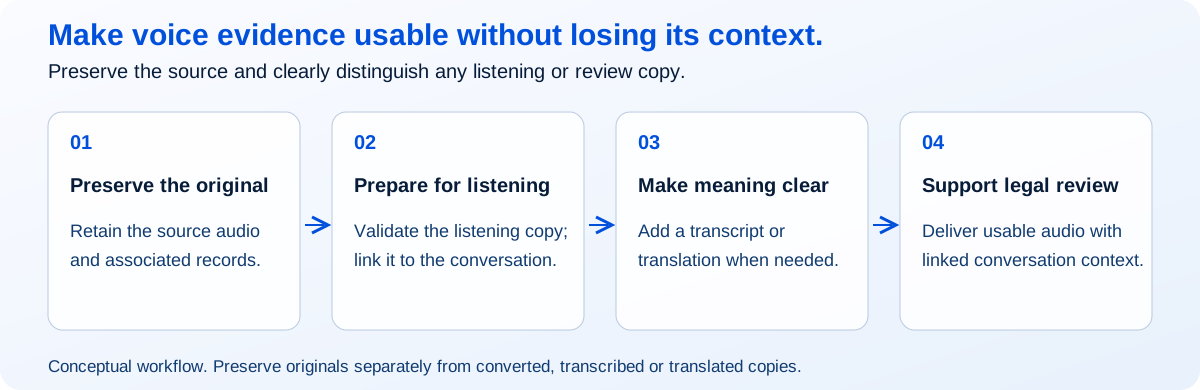
A voice message may carry the most important part of the exchange. A PDF showing an audio bubble tells the reader that a voice message exists; it does not let the reader hear it.
WeChat voice recordings can use SILK-based encoding and application-specific file formatting that ordinary audio players do not readily support. Research presented to the American Academy of Forensic Sciences describes this problem and conversion to WAV for review. Changing a filename extension is not a substitute for properly decoding the audio. [2]
For litigation, the useful outcome is a preserved native recording together with a playable listening copy, linked to the corresponding message in the conversation. The examiner checks the converted audio and documents the conversion so the review copy can be traced back to its source.
A transcript makes a long exchange easier to search and reference. Where translation is required, the original-language audio, transcription and translated text should remain connected. The written version should be reviewed against the recording, with uncertain words identified rather than guessed. Tone, pauses and emphasis may still make the audio itself important.
Prepare a production that counsel can actually use
An effective WeChat evidence production should bring the text and audio together. Depending on the matter, that may include:
-
A chronological conversation export identifying the available participants and message dates.
-
An index linking voice messages and attachments to their place in the exchange.
-
Preserved source audio and separately identified listening copies in an agreed format.
-
Reviewed transcripts or translations where needed.
-
A concise explanation of the collection, verification and any material gaps affecting the legal questions.
Agree on the review and presentation format before production. Test playback in the environment that will be used for the hearing, and keep conversion and handling records. SWGDE’s court-presentation guidance emphasises these practical integrity and playback considerations. [3]
The result should help counsel move from a readable conversation to a particular recording without losing its source or context. Admissibility remains a question for the court; the forensic work provides a clear foundation for assessing and presenting the evidence.
What litigation lawyers should do early
When a matter may involve WeChat evidence:
- Identify the relevant people, accounts, devices and date ranges. Ask whether the important communications include voice messages.
- Preserve the phones and existing backups. Do not reset a device, reinstall WeChat, clear its storage or migrate the account before obtaining forensic advice.
- Record any earlier changes. Note device replacements, lost phones, deleted chats, transfers and steps already taken to collect the conversation.
- Define lawful access and review scope. Address confidentiality, privilege and irrelevant personal information before examination.
- Plan the deliverable. Explain whether counsel needs conversation exports, audio playback, transcription, translation or assistance presenting the evidence.
Power, connectivity and access decisions should be made for the particular device with the examiner. Avoid applying a blanket shutdown or isolation instruction to every phone.
Preserve the conversation. Make the evidence usable.
WeChat evidence requires attention to both collection and communication. The device may hold the conversation counsel needs, while its voice messages require additional preparation before they can be reviewed and presented effectively.
DFI Forensics helps lawyers preserve, examine and explain mobile evidence, with productions shaped around the needs of the matter. If your case involves WeChat messages or voice notes, contact DFI early to discuss the source devices and the evidence you need to establish.
Contact DFI Forensics at 778-742-5621 or dfiforensics.ca/contact.
Request evidence collection
PLAN YOUR EVIDENCE COLLECTION
Bring the conversation into focus.
Tell us what your case needs to establish. DFI will help identify the relevant sources and plan the collection.
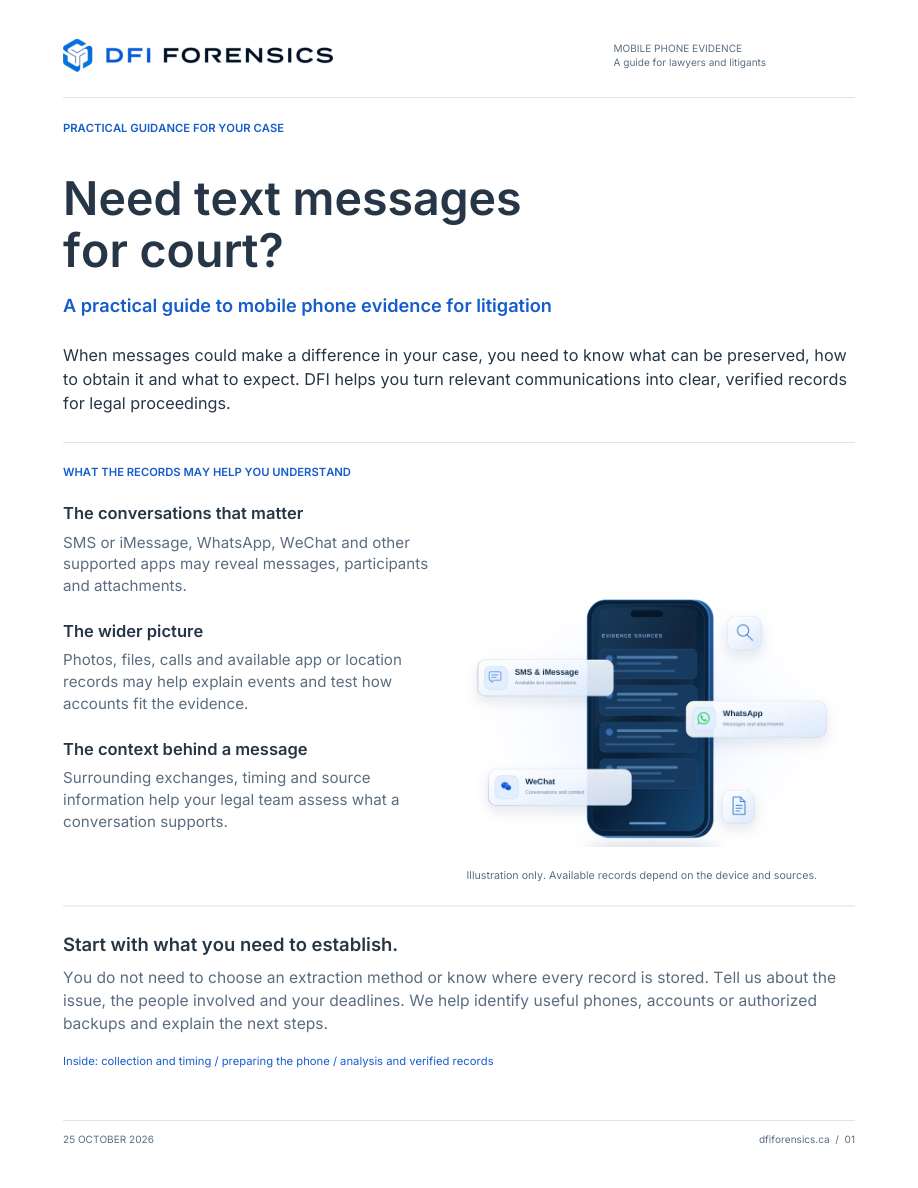
A REFERENCE FOR YOU AND YOUR CLIENT
Mobile Phone Evidence for Litigation
Prepare for the extraction appointment and understand the steps from collection to verified records for legal review.
Download the guide (PDF, opens in a new tab)4-page PDF · Free download · No form requiredTHE PRACTICAL TAKEAWAY
Preserve the source conversation, retain its context and prepare usable records for legal review.
Sources
General information, not case-specific forensic, legal or incident-response advice. An article does not establish an engagement.